
In my extensive experience within the foundry industry, particularly in sand casting high-grade spheroidal graphite cast iron components, I have frequently encountered the challenge of shrinkage defects such as shrinkage cavities and porosity. These defects typically occur at thermal junctions or isolated solidification regions in castings, ultimately compromising the integrity and delivery of the final product. To mitigate these issues, the strategic use of chills, or cold irons, has proven to be an indispensable technique. Chills are defined as metal objects or other激冷materials placed on the surface of sand molds or cores, or within the mold cavity, to locally increase the cooling rate of the casting. This article delves into the practical application of chills in spheroidal graphite cast iron casting, covering material selection, pretreatment methods, scientific principles, and real-world examples, all aimed at preventing casting defects.
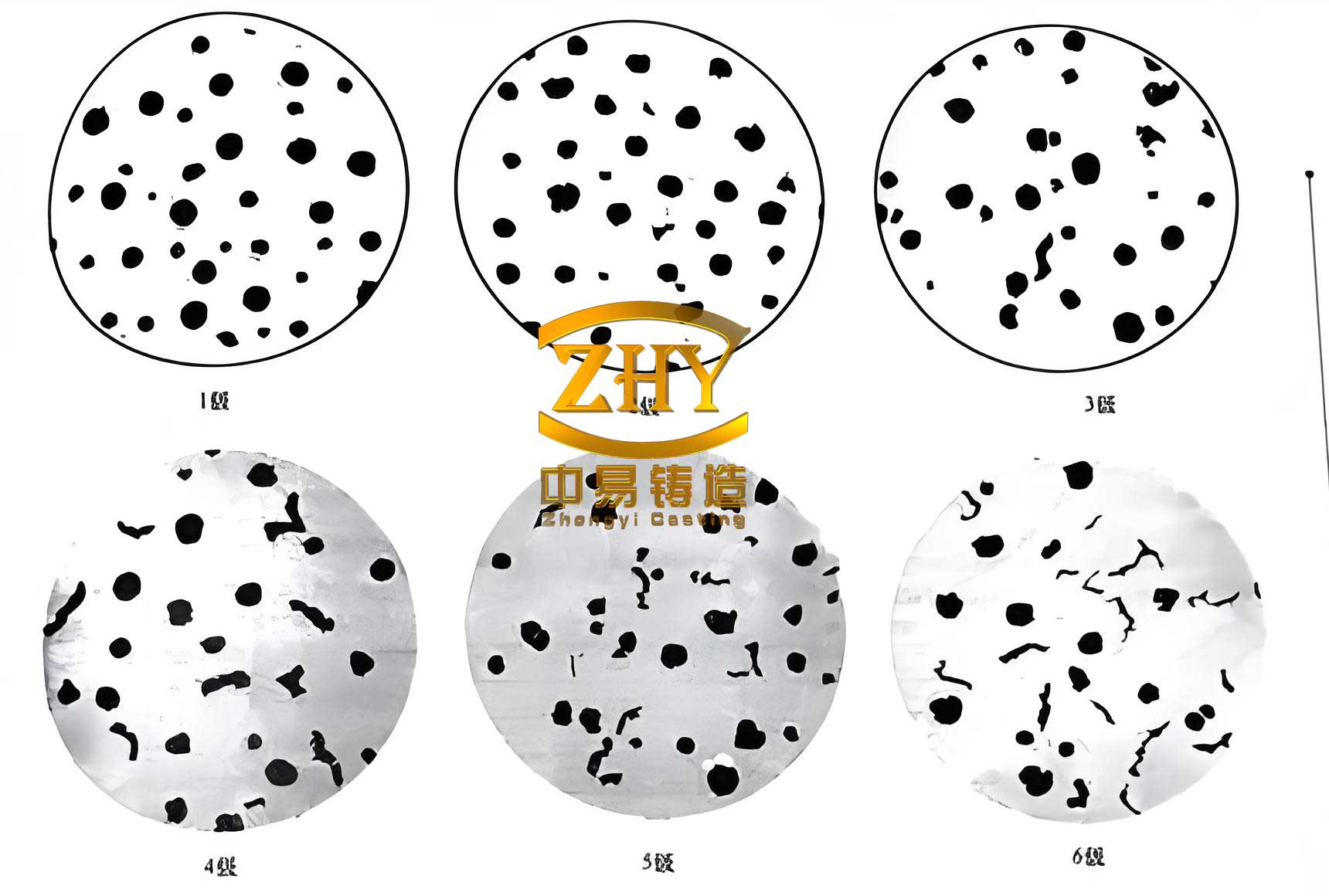
The fundamental role of chills in spheroidal graphite cast iron casting is to control the solidification process. Spheroidal graphite cast iron, known for its excellent mechanical properties due to the spherical graphite nodules, is prone to shrinkage defects because of its unique solidification characteristics. The expansion during graphite precipitation can partially compensate for shrinkage, but in thick sections or isolated areas, inadequate feeding leads to voids. By applying chills, we accelerate cooling in specific regions, promoting directional solidification and ensuring proper feeding from risers. This approach is critical for producing sound castings, especially for high-performance applications like wind turbine components, where reliability is paramount.
When selecting chill materials for spheroidal graphite cast iron, various options are available, each with distinct thermal properties and applications. The choice depends on factors such as the desired cooling intensity, compatibility with the casting material, and economic considerations. Below is a comprehensive table summarizing common chill materials used in spheroidal graphite cast iron casting:
| Chill Material | Typical Composition | Thermal Conductivity (W/m·K) | Melting Point (°C) | Advantages | Disadvantages |
|---|---|---|---|---|---|
| Cast Iron Chill | HT200 (Gray Iron) | ~50-60 | ~1150-1200 | Good thermal capacity, cost-effective, reusable | Heavy, may require surface treatment |
| Steel Chill | Q235 (Carbon Steel) | ~45-50 | ~1400-1500 | High melting point, durable, good for intense cooling | Higher cost, potential for fusion with casting |
| Graphite Chill | High-purity Graphite | ~100-150 (varies with density) | >3500 (sublimes) | Excellent thermal conductivity, lightweight, easy to machine | Fragile, limited reuse, expensive |
| Chromite Sand | Chromite with Furan Resin | ~2-5 (as aggregate) | N/A (refractory) | Good激冷effect, reduces sand-related defects | Not reusable, requires bonding agents |
| Steel Shot | Cut Wire Particles with Binder | ~40-50 (aggregate) | N/A | Flexible placement, good for complex shapes | Preparation needed, may dislodge |
The thermal conductivity of chill materials plays a crucial role in their effectiveness. For spheroidal graphite cast iron, which has a thermal conductivity of approximately 40-50 W/m·K, chills with higher conductivity can rapidly extract heat. The heat transfer rate can be approximated using Fourier’s law: $$q = -k \nabla T$$ where \(q\) is the heat flux (W/m²), \(k\) is the thermal conductivity (W/m·K), and \(\nabla T\) is the temperature gradient (K/m). By increasing \(k\) through material selection, we enhance \(q\), thereby accelerating solidification in targeted areas.
Pretreatment of chills is essential to ensure their proper function and integration into the mold. This involves surface treatment and anti-detachment measures. For cast iron chills, surface preparation typically includes shot blasting or grinding to remove rust, scale, and contaminants, ensuring good thermal contact with the sand. Steel chills require similar treatment, often via grinding or abrasive cleaning. Graphite chills, being more delicate, need careful handling to maintain surface integrity; they can be reused if undamaged. Before placement, chill surfaces are often coated with refractory coatings, such as graphite-based or composite paints, to prevent fusion with the molten spheroidal graphite cast iron and facilitate removal post-casting. The coating thickness should be minimal to avoid insulating effects, governed by the heat transfer equation: $$R = \frac{\delta}{k_c}$$ where \(R\) is thermal resistance (m²·K/W), \(\delta\) is coating thickness (m), and \(k_c\) is coating conductivity (W/m·K). A thin coating minimizes \(R\), maximizing cooling efficiency.
Anti-detachment measures are critical to prevent chills from dislodging during mold handling or pouring. For cast iron chills, handles or protrusions are cast onto non-working surfaces to anchor them in the sand. Steel chills often have handles welded on. Graphite chills may feature machined grooves or slots for sand interlocking. These measures ensure stability, especially in vertical or overhead positions. Additionally, preheating chills before mold assembly is common; using diesel torches or hot air blowers removes moisture and reduces thermal shock, which is vital for spheroidal graphite cast iron casting to avoid gas defects.
The application of chills in spheroidal graphite cast iron casting can be optimized through computational simulations, such as Casting CAE (Computer-Aided Engineering). These simulations predict solidification patterns and defect formation, allowing for precise chill placement. For instance, consider a casting with a stepped geometry prone to shrinkage. By using stepped chills that conform to the contour, we can uniformize cooling. The solidification time \(t_f\) for a region can be estimated using Chvorinov’s rule: $$t_f = C \left( \frac{V}{A} \right)^n$$ where \(V\) is volume (m³), \(A\) is surface area (m²), \(C\) is a constant dependent on mold material and casting conditions, and \(n\) is an exponent (typically ~2 for sand molds). Chills reduce \(t_f\) by increasing the effective \(A\) through enhanced heat extraction.
In practice, the choice between chill materials depends on the specific geometry and thermal requirements of the spheroidal graphite cast iron component. For example, in a casting with a thick flange surrounded by thinner walls, cast iron chills are preferred due to their high thermal capacity, which prevents isolated liquid pools. Conversely, for thin-walled sections adjacent to thick junctions, graphite chills excel because of their superior conductivity, promoting faster heat dissipation without causing premature solidification blockage. This can be analyzed using the dimensionless Biot number: $$Bi = \frac{h L_c}{k}$$ where \(h\) is the heat transfer coefficient (W/m²·K), \(L_c\) is characteristic length (m), and \(k\) is thermal conductivity of the chill (W/m·K). A high \(Bi\) indicates that internal conduction limits cooling, favoring materials like graphite with high \(k\).
To illustrate, I have simulated two scenarios for spheroidal graphite cast iron castings. In the first, a cylindrical component with a thick mid-flange: using graphite chills resulted in an isolated liquid zone, whereas cast iron chills eliminated it by providing more gradual cooling. The heat extraction rate \(Q\) can be expressed as: $$Q = h A (T_{cast} – T_{chill})$$ where \(T_{cast}\) is casting temperature (K) and \(T_{chill}\) is chill temperature (K). Cast iron, with higher heat capacity, maintains a lower \(T_{chill}\) over time, sustaining \(Q\). In the second scenario, a thin-walled tube connected to a thick disk: cast iron chills caused isolated regions due to excessive cooling, while graphite chills achieved balanced solidification. This highlights the importance of matching chill material to the casting’s thermal modulus, defined as \(V/A\).
Beyond material selection, the arrangement of chills influences the solidification morphology in spheroidal graphite cast iron. Multiple chills can be used in series or arrays to control temperature gradients. The effectiveness can be quantified using the chilling modulus \(M_c\), derived from the geometry and thermal properties: $$M_c = \frac{k_{chill} \cdot A_{chill}}{k_{sand} \cdot A_{sand}}$$ where \(k_{chill}\) and \(k_{sand}\) are thermal conductivities of chill and sand, respectively, and \(A_{chill}\) and \(A_{sand}\) are interfacial areas. A higher \(M_c\) indicates stronger激冷, which is desirable for hot spots in spheroidal graphite cast iron castings.
Furthermore, the interaction between chills and the spheroidal graphite cast iron melt involves complex phase transformations. During solidification of spheroidal graphite cast iron, graphite nodules form in an austenitic matrix, with volume expansion that can offset shrinkage. Chills alter the cooling curve, affecting graphite nucleation and growth. The cooling rate \(dT/dt\) impacts nodule count and size, which in turn influences mechanical properties. Empirical relationships show that increased cooling rate from chills can refine graphite structure, enhancing strength. This is captured by the equation: $$N = N_0 \exp\left(-\frac{Q}{RT}\right)$$ where \(N\) is nodule count, \(N_0\) is a constant, \(Q\) is activation energy, \(R\) is gas constant, and \(T\) is temperature (K). Faster cooling lowers \(T\), increasing \(N\).
In addition to traditional chills, innovative materials like exothermic sleeves or insulating pads are sometimes combined with chills to optimize feeding in spheroidal graphite cast iron. These hybrid systems manage temperature gradients more precisely. For instance, placing an exothermic sleeve near a riser while using chills at hot spots ensures progressive solidification toward the riser. The thermal efficiency can be modeled using finite element analysis, solving the heat conduction equation: $$\rho c_p \frac{\partial T}{\partial t} = \nabla \cdot (k \nabla T) + \dot{q}$$ where \(\rho\) is density (kg/m³), \(c_p\) is specific heat (J/kg·K), and \(\dot{q}\) is internal heat source (W/m³) from phase changes.
Quality control in chill usage for spheroidal graphite cast iron involves regular inspection and maintenance. Chills must be cleaned and recoated after each use to prevent contamination. For graphite chills, wear and tear necessitate periodic replacement. Statistical process control can monitor defect rates, with chill effectiveness evaluated using metrics like shrinkage reduction percentage. Data from production runs show that proper chill application can reduce shrinkage defects in spheroidal graphite cast iron by over 80% in critical sections.
To summarize the selection criteria for chills in spheroidal graphite cast iron casting, I present a decision matrix based on casting geometry and requirements:
| Casting Feature | Recommended Chill Material | Rationale | Thermal Consideration |
|---|---|---|---|
| Thick sections with high thermal modulus | Cast Iron or Steel | High heat capacity to absorb substantial heat | Maintain low Biot number for uniform cooling |
| Thin-to-thick transitions | Graphite | High conductivity to prevent isolated liquid | Maximize heat flux at interface |
| Complex contours | Graphite or Custom-shaped Chills | Machinability for precise fit | Ensure full contact area |
| High-volume production | Reusable Cast Iron Chills | Cost-effectiveness and durability | Balance initial investment and performance |
| Critical defect-prone areas | Combination of Chills and Insulators | Fine-tune solidification gradient | Optimize temperature field via simulation |
The economic aspect of chill usage in spheroidal graphite cast iron casting cannot be overlooked. While chills add upfront cost, they reduce scrap and rework, leading to overall savings. The cost-benefit analysis involves factors like material cost, preparation time, and increased yield. For high-value spheroidal graphite cast iron components, such as those in renewable energy systems, the investment in quality chills is justified by enhanced reliability.
In conclusion, the application of chills is a vital technique in the production of high-quality spheroidal graphite cast iron castings. Through careful selection of chill materials—such as cast iron, steel, or graphite—along with proper pretreatment and strategic placement, foundries can effectively prevent shrinkage cavities and porosity. Scientific principles, including heat transfer equations and solidification models, guide the optimization of chill design. Computational simulations further refine the process, ensuring that spheroidal graphite cast iron components meet stringent performance standards. As the demand for durable and efficient castings grows, mastering chill technology remains essential for advancing spheroidal graphite cast iron applications across industries.
Future trends may involve smart chills with embedded sensors to monitor temperature in real-time, adapting cooling dynamically. Additionally, advancements in additive manufacturing could enable customized chill geometries for complex spheroidal graphite cast iron parts. Regardless of innovations, the core principle endures: chills are powerful tools for controlling solidification, safeguarding the integrity of spheroidal graphite cast iron castings, and driving excellence in metal casting.