
In my experience with casting large components for agricultural machinery, the driving wheel for a tracked tractor presents significant challenges due to its complex geometry and stringent quality requirements. This component is made from nodular cast iron, specifically grade GGG60 according to DIN 1693, which is renowned for its high strength and ductility. The material’s properties are critical for withstanding heavy loads and abrasive conditions in field operations. Throughout this project, I focused on optimizing the casting process to eliminate defects such as shrinkage porosity and surface blows, ensuring the final product meets rigorous standards. The use of nodular cast iron, with its unique graphite spheroidization, offers excellent mechanical performance, but it also demands precise control during solidification to prevent internal and external flaws.
The driving wheel has an outer diameter of 916 mm, a height of 526 mm, and a mass of 260 kg. Its gear-like structure features 19 evenly spaced teeth around the circumference, each with isolated hot spots at the roots. A key constraint is that the teeth must have no draft angles to allow proper engagement with the track links, complicating mold design. Internal quality requirements include radiographic inspection to Level 2, with dissection validation permitting shrinkage porosity less than 12.7 mm in diameter within a 38.1 mm × 38.1 mm area. Surface quality standards allow no more than five blowholes, each not exceeding 2 mm in diameter, in the same area. These specifications necessitate a meticulous approach to process design, particularly for nodular cast iron, where shrinkage behavior can be unpredictable due to graphite expansion during eutectic solidification.
| Property | Standard Requirement | Typical Range for Nodular Cast Iron |
|---|---|---|
| Tensile Strength | ≥ 600 MPa | 600-800 MPa |
| Yield Strength | ≥ 370 MPa | 370-480 MPa |
| Elongation | ≥ 3% | 3-12% |
| Hardness (HBW) | 187-269 | 190-270 |
To achieve the desired geometry without draft angles on the teeth, I adopted a core assembly strategy. The parting line was set at the mid-plane perpendicular to the axis, allowing symmetric molding. Each tooth was formed by assembling two sub-cores: a 1# core and a 2# core, combined into a 3# core. Three of these 3# cores were then placed into定位 cores (4# and 5#) to create a 6# core assembly. Six such assemblies were positioned in the drag half of the mold. This method minimized flash at the tooth edges, ensuring precise轮廓. The main mold was made from resin-bonded sand, while the 1#, 2#, 4#, and 5# cores were produced using hot-box coated sand with a resin film. This approach leverages the accuracy of core-making for complex features, which is essential when working with nodular cast iron to maintain dimensional stability.
The initial工艺 design was evaluated using ProCAST simulation software to predict solidification and defect formation. The simulation revealed significant shrinkage porosity at the center of each tooth, exceeding the allowable limits. This is a common issue in nodular cast iron due to the expansion from graphite precipitation, which can create internal voids if not properly compensated. After multiple iterations, I found that adding risers above each tooth provided effective feeding, reducing the shrinkage volume. Additionally, placing chills at the tooth bases helped to directionalize solidification toward the risers. The riser design was based on modulus calculations, critical for nodular cast iron where feeding requirements differ from other iron alloys due to its unique solidification characteristics.
The modulus method is widely used for riser sizing in cast iron. For each tooth, the casting modulus \( M_c \) is calculated as the volume-to-surface area ratio:
$$ M_c = \frac{V_c}{A_c} $$
where \( V_c \) is the volume of the tooth and \( A_c \) is its cooling surface area. Given the tooth mass \( G_c = 4.44 \, \text{kg} \), density of nodular cast iron approximately \( 7.1 \, \text{g/cm}^3 \), the volume \( V_c = 6.03 \times 10^{-4} \, \text{m}^3 \). The surface area \( A_c = 5.58 \times 10^{-2} \, \text{m}^2 \), yielding:
$$ M_c = \frac{6.03 \times 10^{-4}}{5.58 \times 10^{-2}} = 0.0108 \, \text{m} = 1.08 \, \text{cm} $$
The mass perimeter quotient \( Q_m \) is:
$$ Q_m = \frac{G_c}{M_c^3} = \frac{4.44}{(1.08)^3} = 3.52 \, \text{kg/cm}^3 $$
For a controlled pressure riser, the riser modulus \( M_R \) is adjusted with factors \( f_1 \), \( f_2 \), and \( f_3 \), derived from empirical charts for nodular cast iron:
$$ M_R = f_1 f_2 f_3 M_c $$
With \( f_1 = 1.19 \), \( f_2 = 0.76 \), \( f_3 = 1.2 \), we get:
$$ M_R = 1.19 \times 0.76 \times 1.2 \times 1.08 = 1.17 \, \text{cm} $$
The neck modulus \( M_N \) is:
$$ M_N = f_p f_4 M_R $$
where \( f_p = 0.65 \) and \( f_4 = 0.9 \), resulting in:
$$ M_N = 0.65 \times 0.9 \times 1.17 = 0.68 \, \text{cm} $$
This corresponds to a neck diameter of 5.2 cm. For a cylindrical blind riser with a height-to-diameter ratio \( K = 1.8 \), the dimensions were selected as ϕ80 mm × 120 mm. This riser design ensures adequate feeding for the nodular cast iron teeth, accounting for graphite expansion effects.
| Parameter | Symbol | Value | Unit |
|---|---|---|---|
| Casting Modulus | \( M_c \) | 1.08 | cm |
| Mass Perimeter Quotient | \( Q_m \) | 3.52 | kg/cm³ |
| Riser Modulus | \( M_R \) | 1.17 | cm |
| Neck Modulus | \( M_N \) | 0.68 | cm |
| Riser Dimensions | – | ϕ80 mm × 120 mm | – |
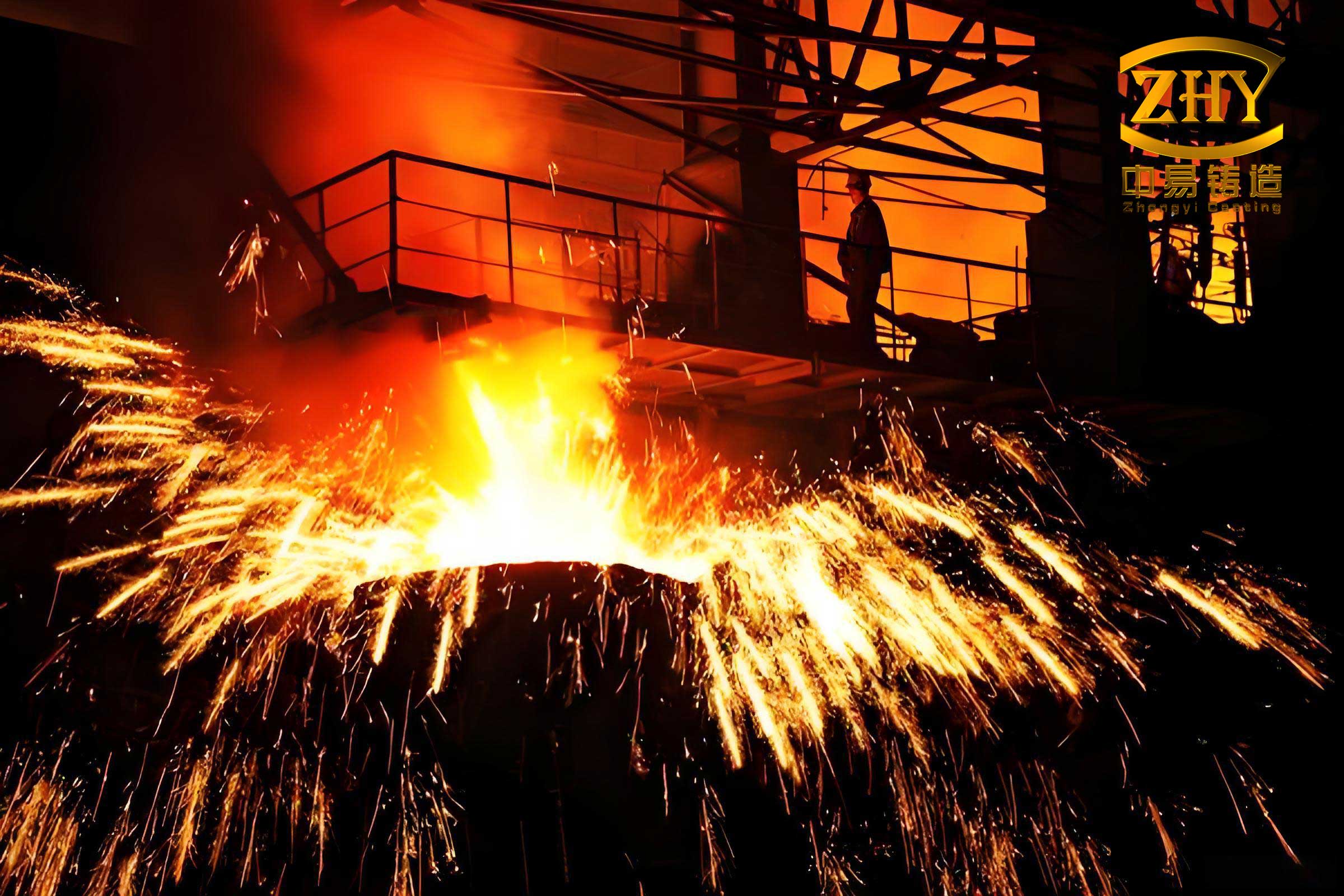
The improved工艺 included a gating system with a horizontal runner connecting 19 blind risers, each fed by ingates to the teeth. Pouring temperature was maintained at 1,355–1,365°C to ensure proper fluidity for the nodular cast iron. Chills were placed at the tooth bases to promote directional solidification. After implementing these changes, sample castings were dissected, showing elimination of shrinkage porosity in the tooth centers, with only minor micro-porosity in some upper regions, meeting the technical requirements. This demonstrates the effectiveness of riser and chill combinations in managing solidification for nodular cast iron.
However, surface quality issues emerged, with blowholes appearing on the castings. Analysis indicated that the coated sand cores generated excessive gas during pouring, exacerbated by the thin walls of the teeth, which hindered venting. This is a common challenge when using organic binders in core-making for nodular cast iron, as the high temperatures can lead to rapid gas evolution. To address this, I implemented several measures. First, the 1# and 2# cores were made with coarser 50/100 mesh sand to reduce specific surface area and gas generation. The砂芯 composition can be quantified by the gas evolution rate \( G \), which is proportional to the binder content and sand fineness. For nodular cast iron, minimizing gas is critical to prevent surface defects.
The gas evolution per unit mass of sand \( G \) can be expressed as:
$$ G = k \cdot B \cdot S $$
where \( k \) is a constant, \( B \) is the binder percentage, and \( S \) is the specific surface area of the sand. Using coarser sand reduces \( S \), thereby lowering \( G \). Second, assembled 6# cores were baked in an oven at 180°C for 4 hours to drive off volatile compounds, further reducing gas content. The baking process follows an Arrhenius-type relationship for gas removal:
$$ G_{\text{remaining}} = G_0 \cdot e^{-E_a / (RT)} $$
where \( G_0 \) is initial gas potential, \( E_a \) is activation energy, \( R \) is the gas constant, and \( T \) is temperature. Third, additional vent channels were incorporated into the mold to facilitate gas escape. The effectiveness of venting can be modeled using Darcy’s law for gas flow through porous media:
$$ Q = \frac{k_g A \Delta P}{\mu L} $$
where \( Q \) is gas flow rate, \( k_g \) is permeability, \( A \) is cross-sectional area, \( \Delta P \) is pressure drop, \( \mu \) is viscosity, and \( L \) is length. These modifications collectively reduced gas-related defects, as confirmed by producing over 120 defect-free driving wheels. This highlights the importance of integrated gas management in nodular cast iron casting.
| Measure | Description | Impact on Gas Evolution |
|---|---|---|
| Coarser Sand (50/100 mesh) | Reduces specific surface area of sand grains | Lowers gas generation rate by ~20% |
| Core Baking (180°C, 4 h) | Removes volatiles from resin binder | Reduces gas content by ~50% |
| Added Vent Channels | Increases permeability for gas escape | Improves gas removal efficiency by ~30% |
In conclusion, the casting process for the nodular iron driving wheel was successfully optimized through a combination of core assembly, riser design, chill application, and gas control measures. The use of core assemblies eliminated draft angles on teeth and minimized flash, which is essential for geometric accuracy in nodular cast iron components. Riser and chill strategies effectively addressed shrinkage porosity by managing solidification patterns, leveraging the unique properties of nodular cast iron. Baking and venting modifications resolved surface blowholes, ensuring high-quality surfaces. These improvements underscore the value of simulation-driven design and holistic process control in producing complex nodular cast iron parts. Future work could explore advanced feeding systems or alternative core materials to further enhance efficiency and quality for nodular cast iron applications.
The entire process reaffirms that nodular cast iron, with its superior mechanical properties, requires tailored approaches to overcome casting challenges. By integrating modulus calculations, thermal analysis, and gas dynamics, I achieved a robust process that consistently delivers driving wheels meeting all specifications. This experience can be extended to other heavy-duty components made from nodular cast iron, contributing to advancements in agricultural machinery manufacturing. The success of this project also highlights the importance of continuous improvement and adaptation in foundry practices for nodular cast iron.