
The landscape of manufacturing is in constant flux, driven by volatile market demands and the relentless pursuit of efficiency. In the realm of foundry operations, this has precipitated a critical re-evaluation of traditional production paradigms. For years, the dominant model was dedicated, high-volume production lines designed for a narrow range of parts. While effective for achieving economies of scale, this rigidity has become a significant liability. Based on extensive hands-on experience in process design and production management, I have witnessed firsthand the necessity and profound impact of injecting flexibility into such specialized systems. The core objective is to transform a line engineered for a single family of sand casting parts into a versatile manufacturing asset capable of producing a diverse portfolio of sand casting parts across a wide spectrum of weights, geometries, and batch sizes, without compromising on quality or economic viability.
The impetus for change is clear. Market dynamics have shifted from a production-push to a demand-pull model. Customers increasingly require smaller batches, greater variety, and faster turnaround. A line that can only produce, for instance, 300-1000 kg steel castings faces existential risk when demand for those specific sand casting parts collapses. The solution lies in flexible manufacturing—a concept encompassing both “system flexibility” (the ability to produce different parts) and “time flexibility” (the speed of changeover between parts). For a sand casting facility, this translates to modifications across the entire process chain: molding, coremaking, melting, pouring, and cleaning. The guiding principles for such modifications must be pragmatic: leverage existing infrastructure to minimize capital outlay, enhance environmental performance by reducing waste and energy use, and incorporate sufficient technological advancement to accommodate future product development.
The following narrative details a comprehensive flexible improvement strategy, drawing from practical implementation. We will explore specific, actionable modifications in each key process area.
Molding and Coremaking: The Foundation of Versatility
The molding station is the heart of any sand casting line. Its flexibility dictates the range of sand casting parts that can be produced. A dedicated line typically features a mixer bound to one binder system, limiting the material properties and applications.
1.1 Dual-Function Sand Mixing System: A pivotal upgrade involves transforming a single-binder mixer into a dual-function unit. Consider a continuous mixer originally configured only for ester-cured sodium silicate sand. To accommodate high-demand ductile iron sand casting parts (3-5 tons) requiring superior surface finish and dimensional accuracy, a furan resin sand capability is essential. The modification is ingeniously straightforward:
- Add auxiliary storage tanks for new base sand, resin, and catalyst adjacent to the existing system.
- Integrate new liquid delivery lines and meters into the mixer’s control cabinet.
- Program a separate mixing recipe into the PLC for the furan system.
The single mixer screw now serves both binder systems. To prevent cross-contamination, the screw is purged by running it empty for several minutes before switching binder types. This allows the simultaneous production of steel and iron sand casting parts on the same line. The economic and environmental benefit is extended by segregating the sand reclamation lines. Shakeouts are routed to dedicated mechanical reclamation units for each sand type, ensuring closed-loop recycling of both silicate and resin sands. The modified system’s capability can be summarized as follows:
| Feature | Traditional Single-Function Mixer | Improved Dual-Function Mixer |
|---|---|---|
| Binder Systems | 1 (e.g., Ester Silicate) | 2+ (Ester Silicate & Furan Resin) |
| Part Material Range | Limited (e.g., only Steel) | Expanded (Steel, Ductile Iron, etc.) |
| Changeover Time | N/A (No changeover) | ~5-10 minutes (for screw purge) |
| Sand Reclamation | Single stream | Dual segregated streams |
1.2 Standardized Modular Tooling for Small Parts: Producing small, sub-100 kg sand casting parts on a line designed for large molds is inefficient. The solution is modularity. Standardized, smaller pattern plates are manufactured. Multiple different part patterns are mounted onto these small plates. For production, several of these small plates are accurately located and locked onto the line’s standard large molding plate using precision pins. This allows the existing flasks and handling system to be used. When a product variant is not required, its small plate is simply swapped out. This approach maximizes equipment utilization and enables rapid changeover for families of small sand casting parts.
1.3 In-Box Squeeze and Lock Coremaking: For complex internal geometries in high-integrity sand casting parts (e.g., for power generation), traditional hand-rammed cores are insufficient. An advanced process derived from shooting principles is employed. Sand is first filled into the bottom core box. Before the binder fully cures, an automatic core assembler brings the top box down, squeezing the sand from both halves together. Interlocking pins (“core locks”) embedded in the design securely fuse the two halves. This process yields monolithic cores with exceptional dimensional accuracy, eliminating internal fins and significantly reducing risks of sand inclusion and poor fusion of chaplets. The result is a superior internal surface finish for critical sand casting parts.
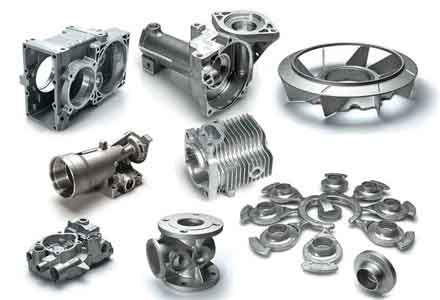
1.4 Adaptable Core Shooting Machines: Horizontal core shooters often become dedicated to one core type. To increase their utility for producing various water-glass-based cores for different sand casting parts, a kit-based approach is used. For each new core box design, a matched set of shooting barrel, blow plate, and shoot plate is manufactured. Changing the core type involves changing the entire tooling kit. This turns a dedicated machine into a flexible one, maintaining the productivity and consistency benefits of shooting for small-to-medium batch core production.
1.5 Robotic Core Setting: Manual placement of large, complex cores introduces variability. Robotic core setting provides a stable, precise, and repeatable solution. The robot is equipped with a vision system to identify and locate the core. An end-effector (custom “fingers”) is designed to gently but securely grip the core geometry. The robot then places it into the mold with sub-millimeter accuracy. This eliminates human error, drastically reduces defects like crushed cores or misalignment, and is easily adaptable to new sand casting parts by changing the end-effector and reprogramming the robot’s path.
Melting and Pouring: Mastering Thermal Management
Flexibility in melting and pouring is not about changing alloys rapidly (though that is possible) but about maintaining precise thermal control for a vastly different mix of part sizes and pouring times within a single heat.
2.1 Extended Pouring Window Technology: Pouring numerous small, intricate sand casting parts from a large ladle (e.g., 30 tons) requires the steel to remain fluid and at the correct temperature for over an hour. Traditional practices lead to rapid heat loss. A series of improvements synergistically extend the usable pouring time:
- Enhanced Ladle Lining: Optimized pre-heating cycles and use of higher-performance insulating materials reduce heat transfer.
- Precision Argon Stirring: Controlled stirring during ladle furnace treatment ensures homogeneous temperature without excessive heat loss to the surface.
- Slag Practice: Maintaining an optimal slag layer acts as a thermal blanket over the molten metal.
- Ladle Cover: A simple insulated lid is used whenever possible to minimize radiant heat loss.
The combined effect can be modeled as a significant reduction in the cooling rate. If the traditional cooling rate is $\frac{dT}{dt}_{traditional} = -0.9 \, ^\circ\text{C/min}$, the improved system can achieve:
$$
\frac{dT}{dt}_{improved} \leq -0.5 \, ^\circ\text{C/min}
$$
This extends the time $\Delta t$ for which the metal remains above a critical pouring temperature $T_{crit}$ from a ladle at initial temperature $T_0$:
$$
\Delta t_{improved} = \frac{T_0 – T_{crit}}{|dT/dt|_{improved}} > \Delta t_{traditional} = \frac{T_0 – T_{crit}}{|dT/dt|_{traditional}}
$$
For example, with a 50°C allowable drop, pouring time increases from ~55 minutes to over 100 minutes.
2.2 Guided Pouring Carriages for Large Parts: Large sand casting parts often require two-point pouring. Traditionally, crane operators manually align a ladle’s nozzles with two pouring cups, a slow and hazardous task. A rail-guided pouring carriage solves this. The pouring basin (sprue cup) is mounted on this carriage, which runs on tracks parallel to the molding line. The crane only needs to position the ladle above the carriage, which is then precisely aligned with the mold by moving along the rails. This cuts pouring time nearly in half, reduces operator exposure to heat and radiation, and ensures consistent pour quality for large sand casting parts. The carriage height is also adjustable via a roll mechanism to accommodate different flask heights.
Cleaning and Heat Treatment: Achieving Consistent Quality
Post-casting operations must adapt to handle the varied sizes, weights, and metallurgical requirements of a flexible product mix.
3.1 Flexible Heat Treatment via Modular Fixturing: A continuous heat treatment line with fixed fixtures is incompatible with a variable product portfolio. The key is to develop a system of modular and multi-hook fixtures. A standard main lifting frame is used on the conveyor. For different part geometries, interchangeable secondary frames or “cradles” are attached. This allows the line to process everything from massive single castings to multiple small sand casting parts in a single cycle. Specially designed multi-hook fixtures distribute the load for heavy parts, increasing safety and fixture life, while also allowing clusters of small parts to be treated together. This ensures consistent, batch-based heat treatment cycles, which is critical for achieving uniform mechanical properties across all sand casting parts, regardless of size. The metallurgical result is a homogeneous normalized microstructure, free from undesirable segregations.
| Aspect | Traditional Dedicated Fixtures | Flexible Modular Fixturing |
|---|---|---|
| Part Compatibility | One specific part | Multiple families of parts |
| Line Utilization | Poor for mixed batches | High, enables mixed-load processing |
| Changeover | Major hardware change | Quick swap of secondary fixture |
| Thermal Uniformity | Good for one part | Engineered for all configured parts |
3.2 Adaptive Cleaning Operations: While shot blasting and cleaning machines are generally tolerant of part size variation, process routing and scheduling become critical. The flexible system uses a Manufacturing Execution System (MES) to group sand casting parts with similar cleaning and finishing requirements. Small parts may be processed in baskets, while large ones are handled individually. The key is the digital tracking and routing of each casting through the appropriate post-processing steps based on its specific quality plan.
Conclusion: The Synergistic Outcome
The cumulative effect of these targeted, principle-driven improvements is the transformation of a rigid production asset into a dynamic, market-responsive manufacturing system. The operational envelope expands dramatically: the same line can now produce sand casting parts weighing from 10 kg to over 5,000 kg. The material palette expands from carbon steels to include low-alloy steels and ductile iron. Production batch sizes can range from single prototypes to thousands, all while maintaining the quality standards and cost efficiencies associated with automated line production. The flexibility is embedded in the hardware (dual mixers, modular tooling, robotic cells) and the processes (advanced thermal management, adaptive fixturing). This journey underscores a fundamental truth for modern foundries: survival and growth are inextricably linked to adaptability. By embracing flexible manufacturing principles, a sand casting facility secures its relevance, mitigates market risk, and positions itself to capitalize on emerging opportunities for high-value, diverse sand casting parts in an increasingly competitive global landscape. The continuous improvement cycle does not end here; it merely establishes a new, more agile baseline from which to evolve further.